

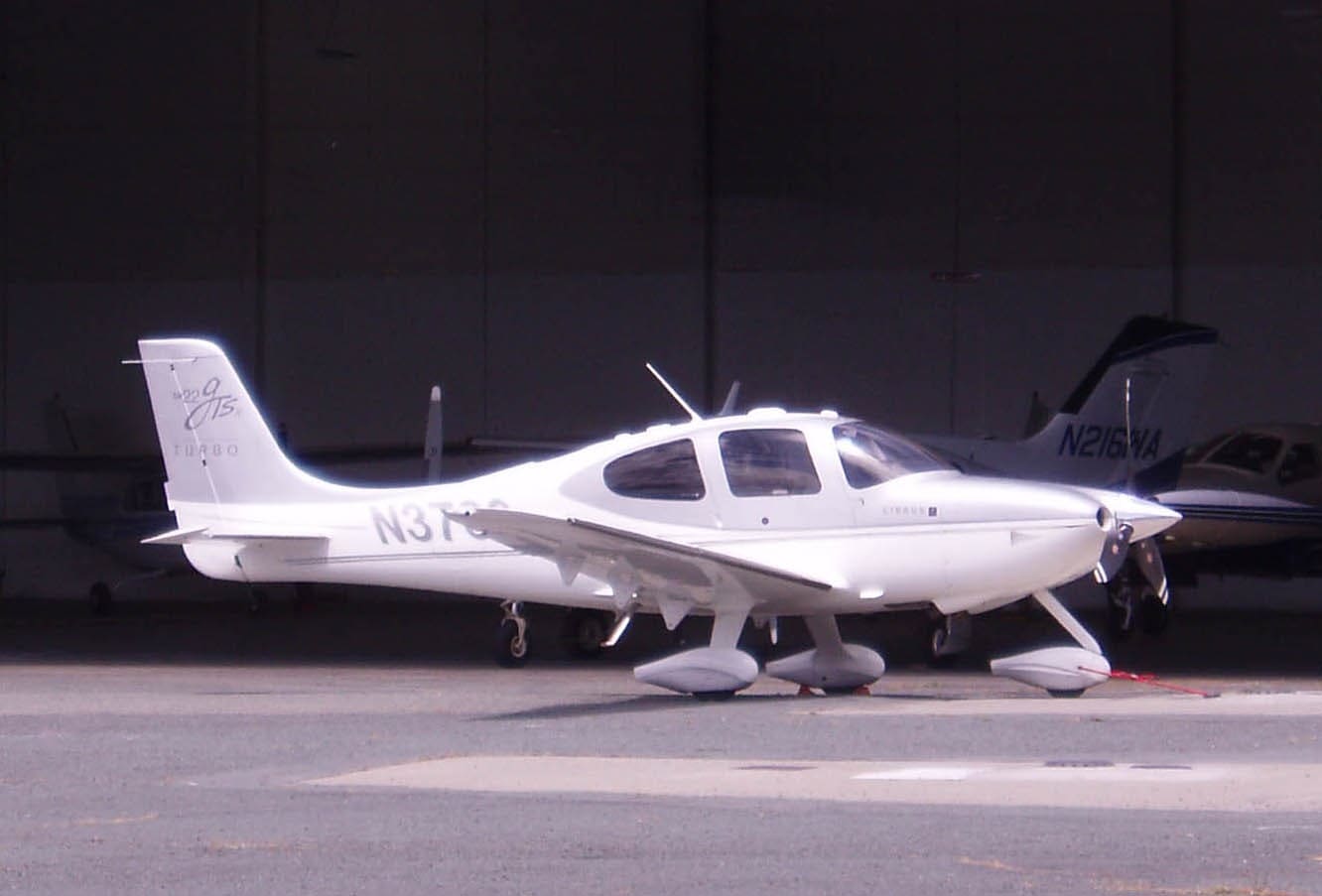
Cirrus SR22 N378C at an open hangar in May 2011. Aircraft context only; no authorized service center affiliation, maintenance event or BWI customer is implied. Photo Bill Larkins, CC BY-SA 2.0. Resized without cropping; derivative under the same license. Photo source License
A Cirrus maintenance business needs an insurance review that follows the aircraft through the shop, across the ramp and back to its owner. An SR22 damaged while being moved, a claim involving completed avionics work and an employee injury are different exposures. Calling the business a Cirrus service center does not establish that one policy responds to all three.
Start with the services your business actually performs, the aircraft it accepts and the responsibilities it takes on. Then compare those facts with the policy wording, limits, deductibles, exclusions and endorsements being proposed. BWI can help you discuss that operation through its aircraft maintenance insurance team. This guide explains the information to prepare and the questions to resolve before you rely on a quote.
Cirrus uses the term Authorized Service Center for its service network. Owners and businesses also search for certified service centers, Cirrus repair shops and Cirrus mechanics. Those search terms do not establish manufacturer authorization, regulatory privileges or insurance protection. Describe your current status accurately and identify the specific work your business is qualified and authorized to perform.
Describe the business before comparing policies
A shop maintaining privately flown SR20 aircraft can have a different insurance submission from one working on SR22T aircraft, operating a mobile repair team or accepting SF50 Vision Jets. Give the insurer your actual aircraft mix. Include the highest individual customer aircraft value and the greatest combined value normally present, along with the higher concentration that can occur during a busy maintenance period.
List inspections, troubleshooting, airframe repairs, engine work, avionics installations, interior work and component handling separately. Explain whether the business performs CAPS-related work, subcontracts specialized tasks or sends components to other vendors. Do not describe a capability as available simply because another location in the manufacturer network performs it. Your submission should match your own premises, personnel and services.
Also identify who owns the business, which entity signs customer contracts and whether other entities own the hangar, employ technicians or invoice customers. A trade name on the door can differ from the legal entity on an application. Ask BWI which entities need consideration under each policy. Entity names should be checked against the actual documents rather than copied from an old certificate.
Separate the principal coverage questions
| Business exposure | Question to resolve |
|---|---|
| Customer aircraft in custody | How are aircraft limits, deductibles and ground movement addressed |
| Completed maintenance work | What liability protection applies after the aircraft leaves |
| Post maintenance flights | Are the flight activity, aircraft and pilots accepted |
| Tools and components | Which owned and customer property is insured and where |
| Employees | Which workers compensation and employer liability arrangements apply |
| Contracts | Which requested endorsements are actually available |
Aircraft maintenance insurance is a discussion about several exposures, not a single promise that everything connected with a repair is covered. Customer aircraft damage, liability after completed work, premises incidents, employee injuries and damage to shop equipment may involve different coverage forms. Some may be combined in a package; others may require separate arrangements. Availability and terms depend on the operation and insurer.
For each proposed coverage, ask what event triggers it, which property or people it concerns, and which exclusions or conditions matter most to your services. Then ask how it interacts with the other policies. A useful comparison records the answer in writing and identifies the actual endorsement or policy section. A coverage name on a proposal is a starting point for that review.
Customer aircraft in your care
BWI identifies aircraft repair businesses and avionics shops among the operations that should consider hangarkeepers liability. The central question is your responsibility for aircraft belonging to others while those aircraft are in your care, custody or control. That is different from insuring the building you occupy, and different from an owner buying hull insurance on an aircraft.
Ask how the proposed form treats aircraft inside the hangar, parked outside, being moved between work areas or temporarily held while waiting for parts. Review any distinction between legal liability protection and other bases of coverage that may be offered. Do not assume the policy pays for every loss merely because the aircraft was on your premises. The circumstances and contract wording still matter.
Discuss limits per aircraft, per occurrence and any aggregate or location restrictions that apply. A limit appropriate for one customer aircraft may be inadequate when several high-value aircraft are exposed to the same event. Deductibles also deserve a separate discussion: determine whether they apply per aircraft, per loss or on another basis. Ask the insurer to explain the proposed application to a clearly labeled hypothetical event.
Movement on the ramp and inside the hangar
Explain who moves aircraft, which equipment is used and whether customers or outside vendors can move aircraft while they are in your custody. Include towing, repositioning, ground runs and other handling activities in the operating description. Confirm whether the proposed coverage has restrictions involving employees, subcontractors, locations or particular activities. A broad description of maintenance work can leave these details unresolved.
Consider a hypothetical situation in which two customer aircraft are damaged during a hangar move. That example can help expose uncertainty about aircraft limits, deductibles and responsibility for the movement. It is not a prediction that a policy would pay. Ask BWI to obtain a policy-specific explanation rather than accepting a general statement that ground handling is included.
Document the business practices your team actually follows. Insurers may ask about access control, movement procedures, staffing and loss prevention. Accurate information is more useful than a polished description of procedures that are not consistently used. When practices change, tell your insurance contact so the application and coverage discussion do not remain tied to an outdated operating model.
Completed repairs need a separate review
A customer allegation can arise after the aircraft has left the shop. The complaint might concern a maintenance task, installation or component supplied during prior work. Ask how products and completed operations liability is addressed, including the applicable limits, exclusions, defense provisions and any aggregate shared with other claims. Do not treat customer aircraft custody coverage as the answer to every completed-work allegation.
Distinguish liability for resulting injury or damage from the cost of correcting your own work. A dissatisfied customer asking for a repair to be redone presents a different question from an allegation that completed work caused additional damage. Ask specifically about faulty workmanship, the work itself, supplied products and resulting damage. Coverage descriptions should not imply that an insurance policy functions as a workmanship warranty.
Explain the services you subcontract and the way you select and document those vendors. If an outside avionics specialist or component repair facility contributes to a job, responsibility can become more complicated. Obtain advice on contracts, vendor insurance evidence and any requested endorsements. A subcontractor certificate does not by itself settle which policy will respond to a particular allegation against your shop.
Test flights and delivery flights
Tell BWI whether anyone connected with your business conducts post-maintenance flights, customer delivery flights, demonstration flights or other flying involving customer aircraft. Identify who arranges the flight, who employs or contracts with the pilot and who decides the aircraft is ready for that operation. These facts should be disclosed before the quote is treated as a suitable fit.
Do not infer in-flight protection from a hangarkeepers policy title. Ask whether flight activity is contemplated, which aircraft and pilots are permitted, and what conditions or exclusions apply. An owner approving a pilot is also a different matter from an insurer accepting that pilot under the relevant coverage. Resolve both the shop’s insurance position and the owner’s policy questions before the flight.
For Vision Jet work, describe SF50 activities specifically instead of assuming a prior piston-aircraft submission covers a turbine operation. The same principle applies when a shop expands into a new model or adds a service it previously outsourced. Insurance review is one part of the preparation; it does not establish regulatory authority, airworthiness or a pilot’s qualification to conduct a flight.
CAPS work and manufacturer status
A shop involved with Cirrus Airframe Parachute System work should identify the precise tasks it performs and the parts or assemblies it handles. Give BWI an accurate description of training, authorization and subcontracting arrangements where relevant. Use current manufacturer information to describe capabilities. This insurance guide does not provide maintenance instructions, service intervals or authorization to perform any CAPS task.
Ask how the proposed policies address the work itself, components held before installation, customer property and allegations involving completed work. Also discuss storage and handling arrangements with the insurer when those facts are relevant to underwriting. A customer’s question about a parachute-related service does not have the same insurance answer as a service center’s question about its business liability.
Manufacturer authorization and insurance should be reviewed on their own terms. Being listed in a service network does not establish a specific insurance limit or eliminate exclusions. Conversely, purchasing insurance does not make a business an authorized Cirrus facility. If a contract requires insurance evidence, compare the actual requirement with your proposal and request confirmation of any endorsement needed to satisfy it.
Avionics installations and customer components
Avionics work can involve an aircraft in the hangar, removed equipment on a bench, newly purchased components and a completed installation. Describe each part of that process. Ask which policy addresses customer components removed from the aircraft, equipment shipped to a specialist and parts waiting for installation. Coverage for an aircraft in custody should not be assumed to answer every question about detached property.
Discuss the work performed at your premises and at other airports. A technician traveling to a customer’s hangar may create a different location exposure from work done inside the main shop. Include tools carried off site, customer property handled during the visit and any vehicle use. Ask whether territorial, premises or subcontracting restrictions affect the proposed response.
When an installation changes the customer’s aircraft value, encourage the owner to review the hull value and equipment description with the owner’s insurance representative. The shop’s business coverage and the customer’s aircraft policy serve different purposes. Updating an invoice or maintenance record does not automatically update the insured value on an owner’s policy or establish how a future loss would be adjusted.
Property employees and business interruption
Prepare a separate inventory of shop-owned tools, diagnostic equipment, inventory, office systems and improvements to leased space. Identify property owned by employees or borrowed from others. Ask how replacement cost, valuation, deductibles and off-premises property are addressed in any proposed property coverage. Building insurance purchased by a landlord should not be treated as proof that the shop’s contents are insured.
Describe employees, working owners and independent contractors accurately. Ask about workers compensation and employer liability requirements with the appropriate insurance and legal advisers for your jurisdiction and business structure. Do not assume an aviation liability policy replaces workers compensation. Payroll, duties and work locations should reflect the operation that will exist during the policy period.
If a covered property loss stops operations, business income and extra expense provisions may become relevant. Ask what triggers coverage, which waiting periods or limits apply and how income values should be established. A parts delay or missed completion date is not automatically an insured business interruption. Compare the triggering language before relying on coverage for a particular interruption scenario.
Contracts certificates and customer expectations
Aircraft owners may request certificates, additional insured status, waivers of subrogation or particular limits. Airport leases and manufacturer agreements may have their own requirements. Collect the actual contract wording early. A summary from memory can miss an endorsement requirement or deadline, while signing first can leave the shop with obligations its proposed insurance does not satisfy.
A certificate generally provides evidence of insurance; it does not replace the policy or create coverage beyond its terms. Ask BWI to explain which requested changes require insurer agreement or an endorsement. Confirm the exact entity name, relevant location, dates and requested status. Do not tell a customer that every party is protected simply because a certificate has been issued.
Ask qualified legal counsel about indemnity provisions, limitations of liability and responsibility for delay or loss of use. Then discuss the insurance implications with BWI. Contractual promises can extend beyond the coverage available. A useful review identifies that difference before work begins and records which issues require a contract change, an endorsement or an explicit business decision.
Prepare a useful submission
Gather the current declarations, policy forms, endorsements and loss information available to the business. Add a service description, location list, aircraft mix, revenue breakdown, employee duties and subcontractor arrangements. Include relevant contracts rather than sending a certificate alone. Explain expected changes such as a second hangar, mobile team, new aircraft capability or additional test-flight activity.
Separate normal values from peak values. A small shop can have an unusually large concentration of customer aircraft when parts delays overlap several jobs. If you do not know the highest combined value, review current aircraft and work scheduling records before guessing. Explain how the estimate was developed so the insurer can ask meaningful follow-up questions.
Keep a record of questions and answers during the quote process. Mark an item unresolved when written confirmation has not been received. That is more useful than recording an optimistic assumption as an agreed term. Before binding, compare the final proposal and endorsements with the information submitted, and resolve any mismatch involving services, entity names, locations or aircraft values.
Compare proposals using the same operation
Price comparisons are meaningful only when each insurer is reviewing substantially the same facts. Send a consistent description of services and values, then compare differences in the actual proposals. One quote may use a different deductible, exclude an activity or offer a different limit structure. Record those differences before deciding whether a lower premium represents better value for your business.
A practical comparison covers customer aircraft custody, completed work, flight activity, premises liability, tools, employee exposures and contractual requirements. For every line, identify the proposed policy or endorsement and any unanswered condition. Some items may be outside the aviation package. Ask where the remaining review belongs rather than assuming an omitted item is included without charge.
There is no responsible universal premium figure for every Cirrus service center. Aircraft values, services, location, revenue, loss history, limits and underwriting terms can differ substantially. An actual submission is the basis for discussing available options. Avoid treating another shop’s premium or an online example as a quote for your operation.
Report changes and potential claims promptly
Review insurance when the business changes, not only at renewal. A new location, a higher-value aircraft, additional flight activity or a different maintenance service can affect the original submission. Ask which changes require prior notice or insurer acceptance. Keep the written response with the policy records so managers understand the limits of what has been confirmed.
If an incident or allegation occurs, follow the notification instructions in the applicable policy and contact BWI promptly. Preserve relevant records and seek guidance before making commitments about responsibility, payment or settlement. BWI provides a public claim-reporting entry point, but the policy’s reporting obligations and the circumstances still need review. This article cannot determine whether a particular event is covered.
Frequently asked questions
Does a Cirrus owner policy replace the repair shop policy
Do not assume that it does. The owner and shop have different interests, insured entities and potential liabilities. An owner may have hull coverage while the shop still faces a claim or contractual dispute. Ask how the respective policies and any subrogation provisions could interact. Obtain a policy-specific answer rather than relying on the owner’s statement that the aircraft is fully insured.
Is certified service center the same as authorized service center
Cirrus identifies its network using Authorized Service Center terminology. People may use certified service center informally when searching, but a search phrase does not verify a shop’s status. Check current manufacturer listings and the business’s actual authorization. Describe regulatory qualifications separately. Neither label establishes that a particular task or claim falls within an insurance policy.
Does hangarkeepers insurance always cover test flights
No universal assumption is safe. Read the proposed coverage and disclose flight activity, aircraft types and pilots to the insurer. Ask about any in-flight exclusions, conditions or separate arrangements. Owner permission, pilot credentials and the shop’s insurance are related facts that need individual review. A policy title or certificate alone does not resolve them.
Should a shop insure every customer aircraft for its full value
Ask BWI to review the proposed limit structure against individual aircraft values and the highest combined exposure. The answer depends on the coverage being considered and the operation. Review per-aircraft, per-occurrence and aggregate provisions where applicable, along with deductibles. Do not substitute a rough fleet average for the value of the most expensive aircraft in your care.
Can a general business policy handle aviation maintenance
Review the actual forms and aviation exclusions before relying on a general business package. Some property or employee exposures may be addressed separately, while aviation activities require their own analysis. Give the insurer a complete operating description. The existence of a commercial policy does not establish that customer aircraft, completed repairs or flight activity are covered.
Get a Cirrus maintenance business insurance quote from BWI
Bring BWI your service list, aircraft types and values, locations, contracts and current insurance documents. Explain whether your operation handles SR20, SR22, SR22T or Vision Jet aircraft, performs specialized work, moves customer aircraft or participates in post-maintenance flights. Those details help the conversation focus on your business rather than a generic repair-shop description.
Start through BWI’s aircraft maintenance insurance page or call 800-666-4359. Ask the team to review customer aircraft custody, completed operations and the other exposures relevant to your services. Available terms depend on underwriting and the actual policies offered. Request written confirmation of coverage and effective dates before relying on an arrangement; a quote request is not a binder.
Sources and related resources
Cirrus service network and support
Find an authorized Cirrus service center
BWI hangarkeepers liability insurance
Continue Reading


