

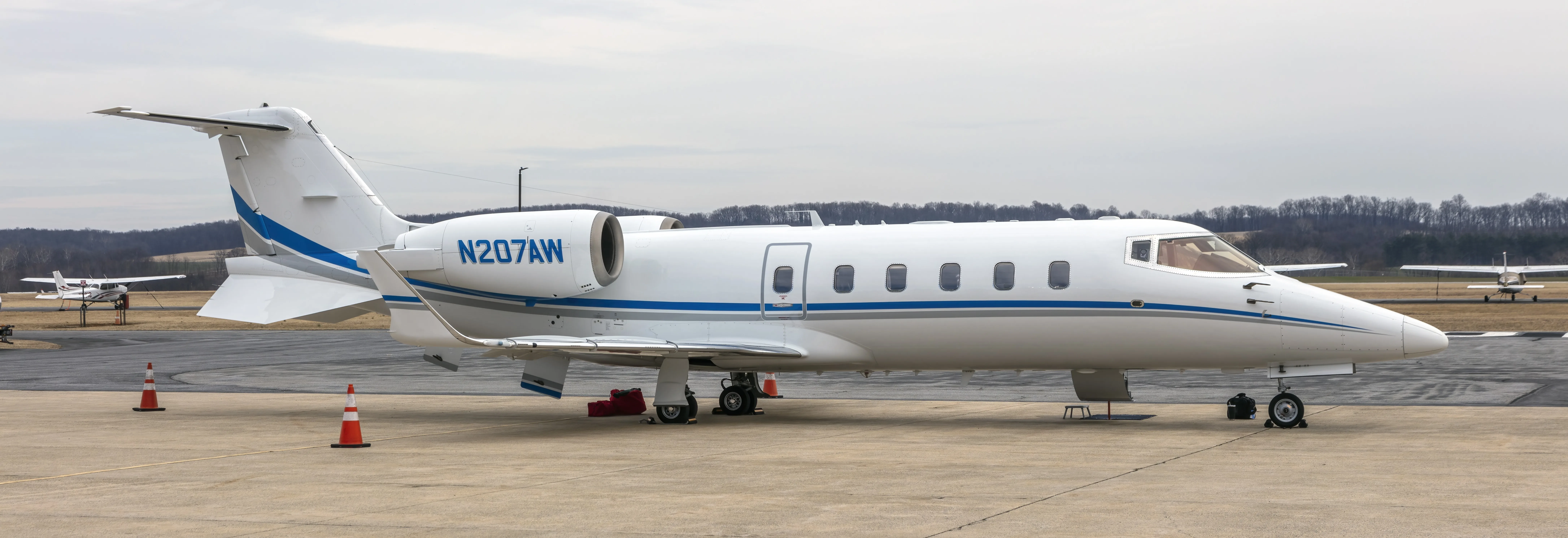
Before buying a preowned Learjet, ask BWI to review the particular aircraft, proposed pilots and intended operation while the purchase is still being evaluated. A purchase price that fits the budget does not establish the insurance terms available for that aircraft. The useful question is whether the proposed insurance arrangement supports the ownership and flying plan you are actually buying into.
An older business jet can have an extensive maintenance history, several ownership changes and equipment that differs from another airplane bearing the same model name. A Learjet 35, 45 or 60 should not enter the submission simply as a generic business jet. Identify the model and individual aircraft, then connect the records, crew and requested coverage to that identity.
This guide addresses insurance preparation during a preowned Learjet acquisition. For broader coverage information, visit BWI’s Learjet insurance page. The discussion does not establish airworthiness, predict an insurer’s acceptance or replace the technical and legal work required for an aircraft purchase. It helps a buyer assemble a coherent insurance request before commitments become difficult to change.
Begin insurance review before the purchase timetable becomes fixed
Give BWI the aircraft information available when you begin serious negotiations. Explain the intended ownership entity, home base, operation and proposed delivery schedule. If a model or specific aircraft has not yet been selected, say so. An initial discussion can identify information to collect without representing a preliminary indication as a final offer for an unidentified airplane.
A buyer may be comparing two Learjets with different equipment, values or histories. Keep separate summaries for each candidate. If the preferred aircraft changes, update the submission rather than assuming the original discussion applies unchanged. The relevant information includes more than the headline purchase price, and the underwriter should know which airplane is actually being considered.
Set a practical sequence with the acquisition team. Aircraft evaluation, crew planning, financing and insurance can proceed together, but each has separate decisions to complete. Leave time to address questions arising from the prebuy inspection or a change in pilots. A signed purchase agreement is not evidence that the insurance review has finished or that the requested coverage is effective.
Identify the exact Learjet and its present configuration
Prepare the model, year, serial number and current registration. Include supported details of installed avionics, significant modifications and cabin configuration when requested. A listing can be a starting point, but the submission should ultimately reflect the aircraft records and the condition being represented at purchase. Resolve conflicting details instead of choosing the description that appears most favorable.
Tell BWI about planned work between closing and routine operation. A buyer might acquire an aircraft, send it directly for avionics changes and only later begin passenger trips. Those are different stages of custody and activity. Identify where the aircraft will be, who will operate it and whether its configuration or requested insured value will change during that sequence.
Avoid applying a model-wide assumption to the individual airplane. A familiar Learjet designation does not explain its maintenance position, operating arrangement or proposed pilots. Provide enough information to distinguish it from the comparison aircraft. That approach makes the insurance discussion more useful than a request to match a premium mentioned by another owner with a different operation.
Use the prebuy findings to update the insurance submission
Have qualified technical professionals evaluate the aircraft and records. Their assessment serves a purpose distinct from underwriting, but findings may change the facts presented to the insurer. If the purchase now includes an extended maintenance visit, a different delivery location or work before flight, communicate the revised plan. Do not leave BWI working from the original sales timetable.
Describe findings factually and use the appropriate supporting records. A discrepancy, proposed repair and completed repair are different conditions. If the scope is uncertain, identify the open question and the person responsible for resolving it. The insurance team should not receive an unsupported statement that all issues are settled while the acquisition team is still negotiating the work.
Insurance is not a substitute for technical due diligence. Ask BWI about the actual coverage wording and exclusions relevant to the transaction, including questions about deterioration, mechanical failure and resulting damage. Do not assume that buying hull coverage creates a maintenance warranty or finances the work needed to make an aircraft suitable for the buyer’s intended operation.
Separate purchase price from the requested insurance value
Explain the value being requested and the information used to support it. Purchase price matters, but it may not describe the aircraft after planned upgrades or include separately held property. Give BWI a clear account of the transaction, equipment and proposed work. Ask how the available policy addresses valuation and settlement before relying on a figure in a financing spreadsheet.
A low acquisition price should not lead to an automatic assumption about the appropriate insured amount. Likewise, adding every planned expense to the hull value without review may create an unsupported request. Have suitable valuation professionals address the aircraft’s circumstances, and ask BWI to explain the insurer’s position on the supported value presented for that particular account.
Keep the lender’s request visible alongside the buyer’s preferences. If the financing requires a particular amount or evidence of an interest, supply the current written requirement. Review differences before closing. Agreement among the buyer, seller and lender on the transaction price does not by itself establish the insurer’s acceptance of the requested policy value or settlement basis.
Present the actual crew rather than a future ideal
Identify the pilots intended for delivery, initial operations and routine trips. Provide the qualifications, experience, recent activity and training information requested by underwriting. If one captain has substantial Learjet experience while another is transitioning from a different aircraft, show those individual facts. Combining their experience into a general description of an experienced crew obscures information needed for the review.
Keep employment and insurance acceptance separate. A captain may have accepted a position while the proposed insurance arrangement remains under review. A contract pilot available for delivery may have a different background from the permanent crew. Ask how each person and role will be addressed, and obtain the relevant response before the schedule relies on that person’s participation.
There is no universal flight-hour threshold established by this guide for older Learjets. The aircraft, model, pilots, use and requested terms must be evaluated together. Ask BWI what information the insurer needs and which conditions accompany the actual offer. Another owner’s accepted pilot arrangement can suggest a question to ask, but it does not establish the requirements for your acquisition.
Coordinate training with the first flights after purchase
Identify completed training and proposed training separately. Provide the course description, model applicability and expected completion record when requested. A reservation is evidence of a plan, not evidence that a course has been completed. If the seller’s delivery deadline arrives before training, raise that conflict while alternative arrangements can still be evaluated by the people responsible.
Clarify the role of any instructor, mentor or accompanying pilot. Ask which activities the offered insurance terms contemplate, how completion is documented and whether an additional review is needed before different flights begin. The presence of an experienced person should not be treated as automatic permission for every pilot combination or use. Retain the actual response with the acquisition records.
Include the training timeline in the operating budget. The practical question is not only the premium but also whether the purchase plan allows the proposed crew to satisfy the offered terms before passengers are scheduled. If a course changes or a pilot becomes unavailable, tell BWI promptly and obtain the relevant review for the revised arrangement instead of improvising around an outdated submission.
Describe ownership and operating responsibilities accurately
Explain who will own the Learjet, who will operate it and who will employ or contract with the pilots. These may be related entities, but they should not be treated as interchangeable names. Provide the acquisition structure and relevant agreements for review. Ask which interests should appear in which capacity under the proposed policy and what evidence can be issued.
The FAA aircraft registration resource addresses registration and ownership documentation. Work with the appropriate advisers on eligibility and filings. Registration records and insurance documents have different functions; supplying one does not establish that the other is complete or that every affiliated company has the protection it expects.
If a management company will handle the airplane, define its services and reporting responsibilities. State whether it supplies crew, arranges maintenance or coordinates insurance. Review its agreement with qualified advisers and ask BWI to evaluate the insurance requests. Do not assume that a management contract transfers every owner exposure or automatically makes the buyer an insured under another party’s policy.
Keep the intended use consistent across the purchase file
State whether the Learjet will serve personal travel, business transportation or a proposed commercial operation. If charter is a future possibility, identify it as a separate proposal rather than letting it disappear from the submission. A buyer’s expectation of eventually generating revenue is not the same as an accepted operating and insurance arrangement at delivery.
Have qualified aviation advisers establish the appropriate operational structure. The FAA’s guidance for aircraft owners and operators is a useful starting resource for evaluating arrangements that require particular care. An insurance quote should not be interpreted as regulatory permission, and an operating approval should not be interpreted as an insurance endorsement.
Check that financing documents, management proposals and insurance applications describe the same intended activity. Differences should be resolved explicitly rather than hidden behind broad labels such as corporate use. If the use changes after an initial quote, ask BWI to review the new facts. The available terms should be assessed against the operation the buyer actually intends to conduct.
Plan the insurance handoff for delivery and immediate maintenance
Create a timeline showing closing, transfer of ownership, delivery flights, maintenance stops and the first planned passenger trip. Give the responsible people access to the same dates and locations. A maintenance delay may move one event without moving another. The insurance handoff should follow the actual transaction rather than a date copied from an early draft of the agreement.
Ask BWI what confirmation is needed before the buyer relies on coverage. Identify the intended effective time and any remaining conditions. Do not assume the seller’s insurance continues for the buyer merely because the seller’s pilot will fly the airplane. Likewise, possession of a quote or application does not establish that coverage has been placed or that every contemplated flight is accepted.
Review storage and custody during any initial work. Supply the shop location, expected duration and proposed aircraft movements. If loaner equipment, detached components or separately owned spares are involved, ask about them individually. The purpose is to identify the relevant interests and activities, not to assume that one aircraft value or a shop’s certificate answers every property question.
Compare coverage proposals before comparing premium totals
Prepare a comparison showing the offered hull value, liability structure, deductibles, pilot conditions and permitted use. Include material limitations and requested interests. Two proposals with different terms should not be presented as equivalent merely because each is described as full coverage. Have BWI explain differences that affect the buyer’s priorities and intended flights.
Ask how defense provisions, passenger limitations and other relevant conditions operate under the offered wording. Do not infer protection from a broad marketing label or the absence of a loss in the aircraft’s recent history. Evaluate what has actually been offered. If a requested limit or condition is unavailable, identify that fact before the acquisition team assumes the insurance budget is complete.
Separate alternatives clearly. A lower premium associated with a different deductible, smaller limit or revised pilot arrangement represents a different choice. Preserve those differences in the decision record. The buyer should understand what each option would require operationally, including training or reporting tasks, before selecting it. Price alone cannot explain whether an offer fits the planned Learjet ownership.
Work through a purchase delay without losing the insurance thread
Consider an illustrative buyer planning to close on a Learjet 60 and send it for cabin work before regular business trips. The prebuy inspection extends the shop visit, the intended delivery captain becomes unavailable and the lender changes its documentation request. These developments affect different parts of the file and should not be reduced to a single instruction to move the date.
Update the aircraft condition and location, submit the replacement pilot and supply the lender’s revised request. Ask BWI which parts of the insurance arrangement need new decisions and which dates remain valid. Keep unresolved items visible to the closing coordinator. A change in one fact does not prove either that all previous terms remain available or that the entire proposal has failed.
Before the aircraft moves, reconcile the supported timetable with the relevant confirmation of coverage and conditions. This example does not establish acceptance, authorize a delivery flight or predict a premium. It illustrates why a preowned purchase benefits from a maintained insurance file rather than a one-time quote request that becomes detached from the transaction as negotiations continue.
Keep a useful ownership file after the purchase
Retain the accepted policy documents, endorsements, pilot information and acquisition correspondence in a location the responsible people can access. Identify who reports future changes to BWI. The owner should not depend on the seller’s coordinator or an outgoing consultant to remember which conditions applied when the airplane was delivered. Transfer the administrative knowledge with the records.
Review planned changes before the aircraft returns to normal use after upgrades or prolonged maintenance. New equipment, revised value, different pilots and new destinations may require attention. The completion of technical work does not automatically update insurance documents. Maintain a clear connection between the actual aircraft and the information on which the current insurance arrangement was based.
At renewal, describe the operation that developed after purchase. Compare actual activity with the initial assumptions and explain material differences. This helps the next review start from supported facts rather than the original sales description. An organized record does not guarantee pricing or claim outcomes, but it gives the owner and insurance team a more dependable basis for continuing decisions.
Preowned Learjet insurance questions
Does an older Learjet automatically cost more to insure
There is no universal premium result based on age alone. Submit the specific model, value, aircraft information, pilots and intended use. Ask BWI to compare the terms actually offered for the account. A general statement about older jets cannot replace underwriting of the airplane and operation you are considering.
Can the seller transfer its insurance to the buyer
Do not assume the seller’s policy protects the buyer after closing. Have the parties establish the intended insurance handoff with their advisers and insurers. Ask BWI to confirm the buyer’s arrangement, effective timing and remaining conditions before relying on coverage for delivery or subsequent flights.
Will hull insurance pay for issues discovered during the prebuy
Do not treat hull coverage as a prebuy repair budget or maintenance warranty. Coverage depends on actual wording, circumstances, exclusions and the relevant insurance period. Have technical professionals evaluate discrepancies and ask BWI about insurance questions without assuming that a future policy will reimburse known acquisition work.
Should insurance wait until the aircraft passes inspection
Begin the discussion while evaluating the purchase, then update the file as inspection findings become available. Early information can support planning, but the final request should reflect the actual airplane, crew and transaction. Identify preliminary assumptions so nobody treats an early conversation as confirmation of completed coverage.
Request a preowned Learjet insurance review from BWI
Send BWI the Learjet model, serial number, registration, proposed value and intended use. Include the ownership structure, pilot information, training plan, current purchase timetable and any expected maintenance before routine operation. Provide available lender and management requirements and identify decisions that remain open so the review follows the transaction as it develops.
Request a Learjet insurance review and quote from BWI. Ask the team to explain the coverage options, conditions and information needed before closing. A well-prepared submission helps you evaluate insurance alongside the aircraft purchase and begin ownership with a clearer understanding of the arrangement you will maintain.
Sources
Continue Reading


