

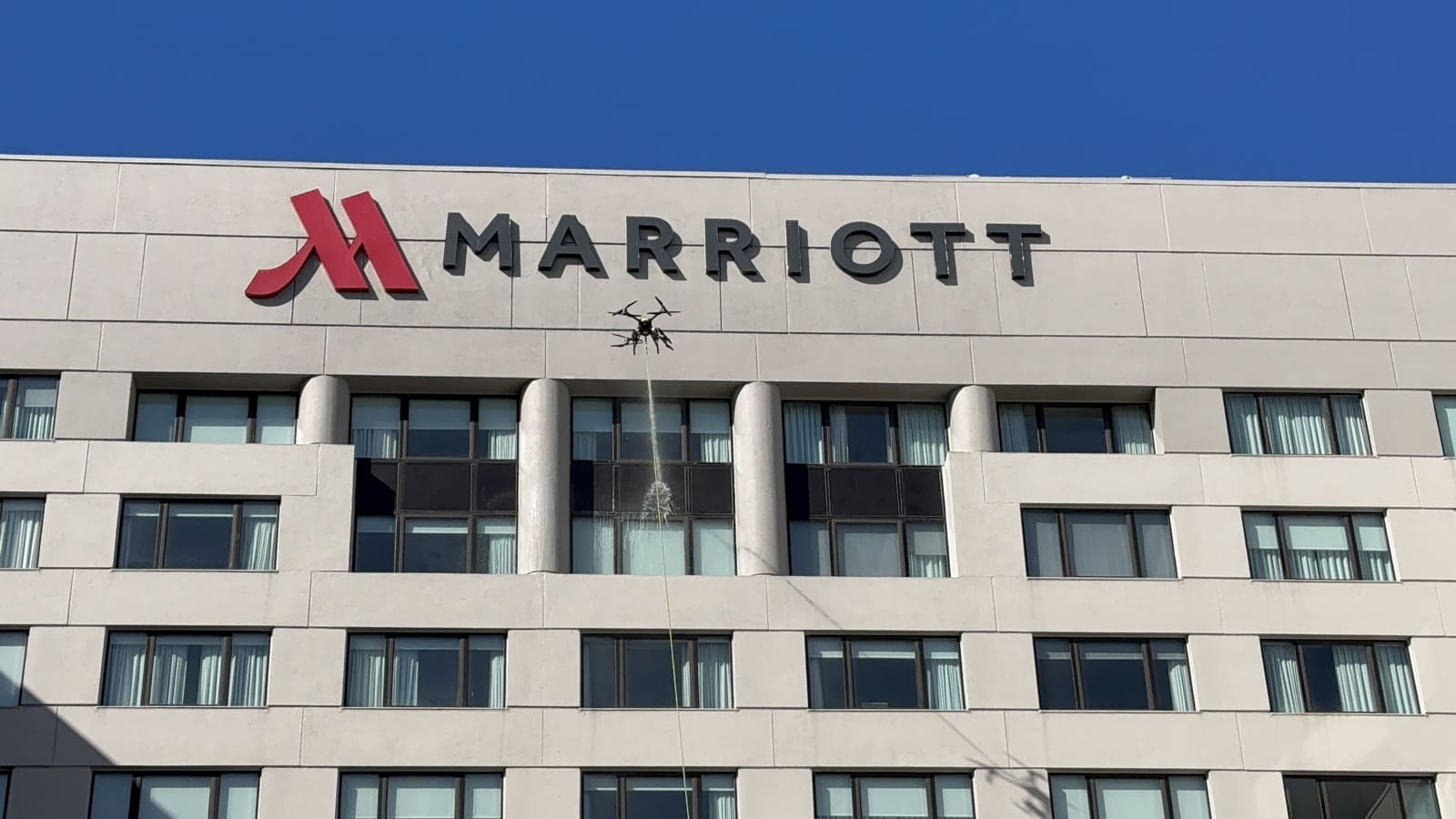
A drone exterior cleaning business should describe the cleaning service itself when requesting insurance, including the aircraft, attached equipment, materials applied and property being worked on. A policy arranged for aerial photography should not be assumed to accept washing windows, treating a facade or supplying fluid through equipment from the ground. Request review before signing the customer agreement or scheduling the first assignment.
The useful starting point is a complete account of the proposed operation, not a certificate showing an impressive limit. At BWI, a drone insurance inquiry should identify who contracts with the building owner, who performs flight and ground work, and what the business promises to deliver. This guide explains the insurance questions for the service; it does not provide cleaning, chemical handling or aircraft operating instructions.
A useful cleaning submission connects four descriptions: the building surfaces in the quotation, the materials actually supplied, the equipment configuration and the responsibility accepted by the cleaning business. If those descriptions disagree, resolve the difference before asking for evidence. This guide concerns insurance preparation rather than cleaning technique, operating approval or a promise that every proposed cleaning operation can be placed through BWI.
Define the exterior cleaning service precisely
Explain whether the business washes glass, cleans exterior walls, removes surface deposits or performs another defined task. Those descriptions should follow the actual work order. A company that records images while a separate contractor cleans presents a different service from one that applies a product using an aircraft. Avoid using inspection as a convenient description if the paying customer is purchasing physical cleaning work.
Describe the delivery system accurately. Identify what the aircraft carries, what remains on the ground and how any connected equipment relates to the aircraft. Include modifications, attachments and the proposed configuration rather than supplying a photograph of a standard drone with no explanation. A reviewer needs enough detail to understand the insured activity without having to infer the arrangement from a marketing video.
State which services are excluded from the contract as well as those included. If workers also clean areas by hand, move ground equipment, supply cleaning materials or provide condition assessments, include those activities in the business description. A customer may purchase one package that contains several kinds of work. The insurance inquiry should cover the package actually offered, with uncertainties identified for clarification.
Identify the parties controlling the job
Provide the legal name of the business signing the agreement. Explain any trading name used in advertising and identify the entity employing or engaging the crew. The property owner, property manager, facilities contractor and tenant may have different roles. Ask the customer to clarify who authorizes the work and who should receive insurance documents, rather than copying every company name into one field without explanation.
If a facilities contractor hires your company as a drone subcontractor, identify who selects the cleaning product, supplies the ground pump and agrees that a surface is suitable for treatment. Record who accepts the finished facade and handles tenant complaints. The property manager might arrange access while the prime contractor directs the cleaning service. Those roles should remain attributable to the actual parties rather than grouped under the word client.
Also identify anyone subcontracted by your own business. A separately engaged pilot and a cleaning technician supplied by another firm do not necessarily have the same relationship to the insured company. Provide agreements and relevant insurance requirements for review. Do not assume each contractor’s certificate transfers every potential responsibility away from the business that sold the customer the finished service.
Distinguish flight liability from damage to the work
A drone can be involved in allegations beyond an airborne collision. A customer might allege that cleaning damaged glazing, allowed water into an area or affected a neighboring surface. Describe these possibilities as service exposures for review, without asserting that any particular policy covers or excludes them. The nature of the alleged loss and the wording of the applicable contracts would matter.
Ask how the proposed program addresses property being worked on and property in the business’s care, custody or control. These are wording questions, not labels that can be settled by calling every surface third party property. Supply the actual service agreement and an example of the property involved. A generic liability summary may leave important questions unanswered about the surface receiving the treatment.
Separate the aircraft’s own damage from harm alleged by someone else. A damaged drone, an affected building and a demand to redo unsatisfactory work are different subjects. Identify the protection sought for each instead of assuming one large liability limit reimburses the equipment owner, pays all customer complaints and finances every repeat visit. Ask for the relevant terms and unresolved limitations to be explained.
Compare the contract with the insurance request
Use the following comparison to organize the review. Each subject points to facts that the business can supply and a specific question to resolve. The table is not a coverage schedule. A requirement in the customer’s contract becomes part of the submission for review; its presence does not establish that an insurer has accepted the wording or that the business can meet it.
Provide the complete agreement, including the work description and insurance exhibit. A separate procurement checklist may omit indemnity language or promises in the scope of services. Note the version and any proposed changes. If a customer later adds cleaning areas, expands the service or changes the contracting entity, submit that revision before relying on a review of the earlier document.
Keep proof of insurance consistent with issued policy documents. Ask about requested additional insured wording, waiver provisions or other special terms through the appropriate process. A certificate is evidence about the insurance described on it; it should not be treated as permission to perform every task at the property or as a way to create protection absent from the applicable policy and endorsements.
| Contract subject | Facts to submit |
|---|---|
| Service | Actual surfaces tasks delivery system and promises |
| Parties | Customer prime subcontractor and crew relationships |
| Equipment | Aircraft attachments ground equipment and ownership |
| Materials | Products supplier selection and environmental questions |
| Property | Work surface neighboring property and responsibilities |
| Documents | Final agreement accepted operation and issued evidence |
Describe cleaning materials without making assumptions
Identify the proposed product by its actual supplier description and provide the relevant product information requested for review. State whether the customer supplies it or your business purchases it, and who accepts responsibility for selection. If the customer later substitutes a different substance, preserve the change in the work order. Words such as natural, mild or environmentally friendly cannot establish how an insurance exclusion applies or replace the qualified assessment of a material.
Treat an alleged release or contamination concern as a separate unresolved insurance question. Give the relevant insurance adviser the actual material and allegation; do not promise an environmental placement from BWI based on the drone quotation. For a cleaning contract, damage to a treated surface, liquid affecting another property and cleanup demanded by a customer need their own review. A higher aviation limit does not by itself answer those different questions.
The FAA dispensing resource says not all substances fall under Part 137 and directs operators to check the proposed activity against the applicable definitions. Have qualified aviation advisers establish the requirements for the actual cleaning proposal. This guide makes no blanket determination that facade cleaning requires, or is exempt from, that framework. Record the verified status accurately; property access, aviation authority and insurance acceptance each require their own evidence.
Include the complete aircraft and ground equipment inventory
List the actual aircraft, serial information, ownership and values requested for review. Describe attached systems and any material modifications. If the business uses a leased aircraft, include the lessor’s requirements and the agreement governing damage. A value quoted for a standard aircraft may omit a specialized attachment or other expensive equipment that the business expects to replace after a loss.
Inventory ground equipment separately, including pumps, controllers, hoses, power sources and transport equipment where relevant to the real setup. Identify which company owns each category and where it is kept between jobs. Ask what insurance is intended to address these items in storage, transit and use. Aviation equipment coverage should not be assumed to include every item located beside a drone at the job site.
Keep supplier warranties, rental terms and insurance documents distinct. A warranty may address certain product obligations without insuring accidental damage or a customer’s liability demand. Similarly, a rental deposit is not an insurance limit. If the business has committed to replacing rented equipment at a stated value, bring that obligation into the review before accepting the contract or taking possession of the equipment.
Account for the building and surrounding activity
Explain the kind of property and the areas included in the contract. An occupied office, residential building and industrial facility may involve different customer requirements and access arrangements. Provide the site information requested for underwriting rather than assuming all exterior walls create an identical exposure. If the owner has special restrictions, include them with the work order and identify who is responsible for resolving them.
Describe the relationships with tenants, neighboring property and other contractors when relevant. The insurance discussion may need to consider allegations involving people or property outside the immediate cleaning surface. This guide does not prescribe exclusion zones, flight distances or job site controls. The responsible qualified people must establish appropriate operating and work arrangements for the specific site, independently of the insurance submission.
Site permission is also separate from aviation authority. A property manager’s approval does not answer every airspace or operating question. The FAA’s commercial operator resources provide a starting point for locating applicable requirements, but the crew must establish what applies to its own aircraft and operation. An insurer’s quote should never be read as a substitute for the necessary legal and technical review.
Review workmanship promises and business losses
Read the performance promises in the service contract carefully. A commitment to clean specified areas differs from guaranteeing that every stain will disappear or that the building will remain free of a condition for a stated period. Tell the insurance reviewer what the business actually promises, including any obligation to repeat work, refund fees or pay another contractor to complete an unsatisfactory assignment.
Ask how those obligations relate to the proposed protection. Liability insurance should not be assumed to function as an unlimited workmanship guarantee. A customer complaint about the quality of a finished service may raise different questions from an allegation of physical property damage. Preserve that distinction when requesting options, while allowing the actual facts and wording to determine the treatment of any later demand.
Weather delays, equipment failure and site access changes can also affect revenue. Identify cancellation terms, rescheduling commitments and any promised penalties. Keep those commercial obligations separate from the aircraft and operational liability request. Do not present BWI’s drone inquiry as an offer of business interruption, guaranteed revenue or reimbursement of contractual penalties. Have appropriate advisers assess the actual commitments and leave any unsupported protection unresolved.
Plan the review before the first contract starts
Prepare the business description, sample agreement, equipment inventory and crew information together. Include the proposed start date and identify decisions still pending. If the aircraft configuration has not been finalized, describe the alternatives rather than selecting one merely to complete an application. Ask which changes require resubmission and retain the written response with the version of the proposal that was reviewed.
Compare quotations using the same facade scope, materials supplier, aircraft configuration and ground-service responsibilities. A response addressing photography is not an equivalent answer to one addressing physical cleaning, even if both show the same aircraft and liability limit. Mark exclusions, pending information and conditions visibly. When the proposal omits a material or ground system, obtain clarification before comparing price or telling the facilities manager that the complete service has been evaluated.
Before work begins, reconcile the agreed arrangement with the issued documents and outstanding conditions. Record any unresolved subject instead of treating payment of a premium as proof that every requested change was completed. The business should be able to identify what was submitted, what was accepted and what documentation supports that understanding. Maintain the separate record of required operating and site permissions.
Make the service description consistent across documents
Compare the estimate with the final scope by surface and task. If sales promises stain removal, restoration or treatment while the application describes washing only, identify that difference. A wall photograph may show the intended area without explaining the result the business guarantees. Have the appropriate professionals reconcile the actual service before submitting it. Insurance wording should be assessed against the promise accepted, rather than a narrower description selected for the application.
Keep examples of the advertised service available when requested, while distinguishing promotional images from the actual equipment configuration. A manufacturer’s demonstration can illustrate a concept without establishing that your company owns that platform or has the same permissions. Supply the specifications and arrangements that apply to your business. If a planned attachment is still being evaluated, identify it as proposed rather than already installed.
Assign responsibility within the business for submitting meaningful changes. Sales staff may agree to an additional material or a new surface before the operator learns about it. A simple internal handoff should ensure the actual job is compared with the accepted description and required reviews. Document the response to a changed proposal before allowing an earlier certificate or quotation to stand in for the new decision.
A fictional facade cleaning contract review
Imagine a company that has previously provided aerial photography and now wants to offer exterior cleaning. Its first customer is a property manager, but the contract is issued by a separate facilities business. The proposal includes an aircraft supplied by the drone company, ground equipment rented from another firm and materials selected by the cleaning subcontractor. The initial inquiry describes the new service before any certificate is requested.
During review, the customer adds a requirement for work on an additional surface and inserts a broad performance promise. The company supplies the revised document rather than assuming the earlier insurance discussion accepted the change. It also separates the aircraft value from rented equipment obligations. Questions about damage to the cleaning surface and environmental allegations are raised explicitly, with no assumption that a photography policy answers them.
The company keeps the final documents and any unresolved questions before deciding whether to accept the assignment. This fictional illustration is not a BWI claim, pricing example or promise that the proposed operation can be placed. It shows why the useful insurance review follows the actual contract and equipment arrangement rather than beginning and ending with a certificate request.
Questions exterior cleaning operators ask
Is ordinary drone photography insurance enough for cleaning work
Do not assume it is. Supply the new service description, delivery system, materials and contract for review under the actual program. A business moving from collecting images to physically cleaning property has changed the activity being offered. Ask for the accepted scope and relevant limitations to be documented before relying on protection arranged for a different service.
Does a tether remove the need to review aircraft insurance
A connection to ground equipment does not by itself answer insurance or regulatory questions. Describe the aircraft, connection, equipment and actual operation. Ask the relevant insurance and aviation reviewers what applies to that configuration. Avoid treating a single design feature as proof that all flight, equipment, customer property or operating authority questions have disappeared.
Will drone insurance pay to redo an unsatisfactory cleaning job
That cannot be assumed from a general liability or aircraft coverage description. Supply the workmanship and repeat service promises for review. A demand to redo work, an allegation of damage and loss of the aircraft are distinct subjects. The actual policy and circumstances determine whether any protection applies; a customer contract cannot independently create an insurer’s obligation.
Should a new cleaning location be reviewed before every assignment
Ask what location information and changes the actual program requires. A standing business description may not resolve every unusual site, material, contractual demand or proposed operating change. Maintain a process for identifying differences and submitting them when required. Include enough detail for a meaningful response instead of relying only on the statement that the next assignment is another building.
Bring the complete cleaning proposal to BWI
Request a drone insurance review and quote from BWI with the exterior cleaning agreement, actual aircraft configuration, materials, equipment ownership and crew relationships. Identify whether you are the prime contractor or supplying one part of another business’s service. Include the questions about property being worked on, ground operations, environmental allegations and performance promises that matter to your proposed contract.
Ask which options can be considered for the real operation and what further information is needed. Keep the resulting policy documents, endorsements and accepted business description together with the contract version reviewed. That record gives the business a clearer basis for its insurance decisions as the service develops, while qualified operational and legal advisers address their respective requirements for each proposed assignment.
Continue Reading


