
One of the most common questions we hear from Beechcraft owners is:
“Which Bonanza costs more to insure—the V35 or the F33A?”
It’s a fair question.
Both aircraft are legendary. Both are respected throughout aviation. Both offer outstanding performance, strong owner loyalty, and decades of proven history.
Yet many buyers assume there must be a significant insurance difference between the two.
The reality is more complicated.
At BWI Aviation Insurance, we analyzed 110 Beechcraft insurance renewals during the first quarter of 2026 representing more than $395,960 in annual premium.
The results showed that the biggest driver of Bonanza insurance premiums is usually not whether an aircraft is a V35 or an F33A.
Instead, insurance companies focus primarily on:
- Pilot experience
- Aircraft value
- Claims history
- Instrument rating
- Time in make and model
- Recent flight activity
- Recurrent training
In many cases, two nearly identical Bonanzas can have dramatically different premiums simply because the pilots behind the controls have different experience levels.
The Good News For Bonanza Owners
Before comparing aircraft, let’s start with the overall market.
Our Q1 2026 Premium Intelligence Report found that Beechcraft owners experienced one of the strongest insurance markets among major piston aircraft categories.
Among the 110 Beechcraft renewals analyzed:
- Weighted average premium movement was a decrease of 19.6%.
- Median premium movement was a decrease of 3.8%.
- Most policies remained stable or improved.
- Competition among carriers increased substantially.
For many Bonanza owners, that means today’s insurance environment is considerably better than it was several years ago.
Understanding The V35 Bonanza
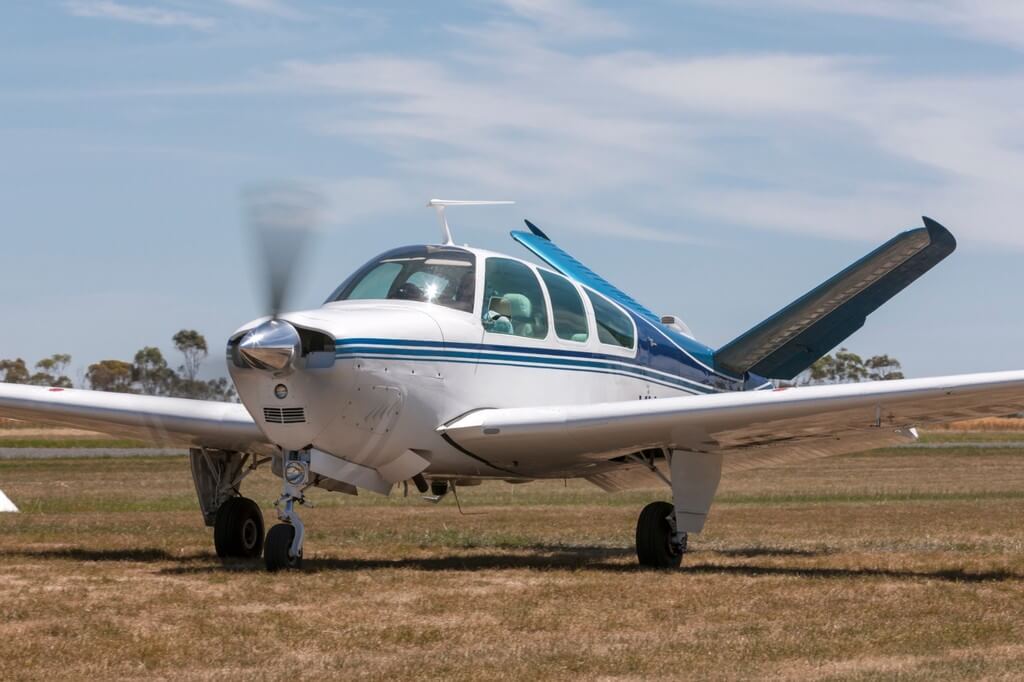
Few aircraft are more recognizable than the V-tail Bonanza.
Models such as:
- V35
- V35A
- V35B
- V35TC
remain highly sought after by aircraft owners across the country.
The V-tail design has become one of the most iconic silhouettes in aviation history.
Today’s V35 owners are often passionate about the aircraft’s:
- Performance
- Efficiency
- Handling characteristics
- Classic styling
- Historical significance
Insurance companies have decades of claims data available on V-tail Bonanzas.
Because of that experience, insurers generally understand these aircraft very well.
Contrary to popular belief, most underwriters today do not automatically penalize V-tail Bonanzas simply because they are V-tail aircraft.
Instead, they focus on the pilot.
Understanding The F33A Bonanza
The F33A is often viewed as the evolution of the Bonanza platform.
It delivers many of the same performance characteristics while utilizing a conventional tail configuration.
Many owners appreciate:
- Excellent handling
- Strong payload capability
- Modern upgrade potential
- Broad parts availability
- Stable resale value
The F33A continues to attract pilots looking for a high-performance piston aircraft that can comfortably handle serious cross-country travel.
Insurance companies generally view the F33A very favorably.
Like the V35, however, pilot qualifications remain the primary underwriting consideration.
Which Aircraft Is More Expensive To Insure?
This is where many buyers are surprised.
There is no universal answer.
If all variables were equal, insurance costs between a V35 and an F33A are often far closer than buyers expect.
The larger influences are usually:
- Aircraft value
- Pilot qualifications
- Claims history
For example:
A highly experienced V35 owner with 2,000 hours, an instrument rating, and 500 hours in make and model may receive a lower premium than a lower-time F33A pilot transitioning into the aircraft for the first time.
The pilot frequently matters more than the airplane.
Aircraft Value Often Drives The Biggest Difference
Many owners focus on aircraft model while overlooking the factor that often matters most.
Hull value.
Today’s Bonanza market spans a wide range of values.
Some older aircraft may be insured for:
- $125,000
- $175,000
- $250,000
Meanwhile, heavily upgraded Bonanzas often carry values exceeding:
- $400,000
- $500,000
- $600,000
Modern avionics alone can dramatically increase insured value.
Aircraft equipped with:
- Garmin GTN navigators
- Garmin G500 TXi displays
- Digital autopilots
- Modern engine monitors
may carry substantially higher hull values than otherwise similar aircraft.
As value increases, premium generally increases as well.
Why Insurance Companies Care About Instrument Ratings
Bonanzas are frequently used as serious transportation aircraft.
Many owners routinely fly:
- Long cross-country trips
- Business travel
- IFR missions
- Multi-state operations
Because of this, underwriters place substantial value on instrument ratings.
An instrument-rated pilot often receives more favorable underwriting treatment because they have demonstrated additional proficiency and training.
For many Bonanza owners, earning an instrument rating can improve both safety and insurability.
Get Your Bonanza Aircraft Insurance Quote With BWI Today>>
Time In Make And Model Matters
One factor that consistently appears in underwriting decisions is time in make and model.
Insurance companies recognize that Bonanzas are high-performance aircraft.
A pilot with substantial Bonanza experience often receives stronger consideration than someone transitioning into the platform.
This is true regardless of whether the aircraft is a V35 or an F33A.
Underwriters generally prefer pilots who have demonstrated proficiency in the specific aircraft they operate.
Claims History Remains Critical
Nothing impacts insurance pricing more consistently than claims history.
Pilots with clean records often benefit from:
- More carrier options
- Greater underwriting flexibility
- Better long-term pricing stability
Pilots with recent losses may face reduced carrier appetite regardless of aircraft type.
Whether you fly a V35B or an F33A, maintaining a clean claims history remains one of the strongest ways to preserve favorable insurance options.
Which Aircraft Is Easier To Insure?
This is another question we hear frequently.
In today’s market, both aircraft are highly insurable for qualified pilots.
Insurance companies have extensive experience underwriting both models.
Neither aircraft is considered unusually difficult to insure.
The larger challenge usually involves pilot qualifications rather than aircraft selection.
A well-qualified owner will generally find strong carrier interest in either aircraft.
Which Aircraft Should You Buy?
Insurance should be part of the buying decision, but it should not be the primary factor.
The better question is:
Which aircraft best fits your mission?
If you love the history and aesthetics of the V-tail Bonanza, insurance costs alone are rarely a reason to avoid it.
If you prefer the conventional-tail F33A and its reputation, insurance costs alone are rarely a reason to avoid it either.
The mission, aircraft condition, maintenance history, and pilot preference usually matter far more than minor insurance differences.
How Bonanza Owners Can Improve Their Insurance Profile
Regardless of which aircraft you fly, there are several ways to improve your insurance profile.
Maintain an instrument rating.
Participate in annual recurrent training.
Fly consistently throughout the year.
Build time in make and model.
Maintain accurate logbooks.
Keep a clean claims history.
Complete transition training when moving into a new aircraft.
Insurance companies consistently reward pilots who demonstrate professionalism and commitment to safe operations.
Why Thousands Of Bonanza Owners Trust BWI
BWI Aviation Insurance has helped thousands of Beechcraft owners insure their aircraft.
Whether you fly a V35, V35A, V35B, F33A, S35, G35, M35, N35, or another Bonanza variant, our team understands the underwriting factors that influence pricing and carrier appetite.
We work with leading aviation insurance companies and help aircraft owners compare options based on their specific aircraft, experience level, and mission profile.
Final Thoughts
When comparing the V35 and F33A, most owners are surprised to discover that insurance companies focus far more on the pilot than the tail configuration.
While aircraft value certainly matters, the biggest underwriting factors remain:
- Pilot experience
- Instrument proficiency
- Claims history
- Time in make and model
- Recurrent training
The good news is that today’s market remains favorable for qualified Bonanza owners.
Our review of 110 Beechcraft renewals during Q1 2026 showed a weighted average premium decrease of 19.6%, making this one of the strongest insurance environments Bonanza owners have seen in years.
Whether you’re flying a classic V-tail or a modern F33A, understanding how insurance companies evaluate risk can help you secure better coverage, stronger pricing, and more confidence at renewal.
bwifly.com / 800-666-4359
Continue Reading